
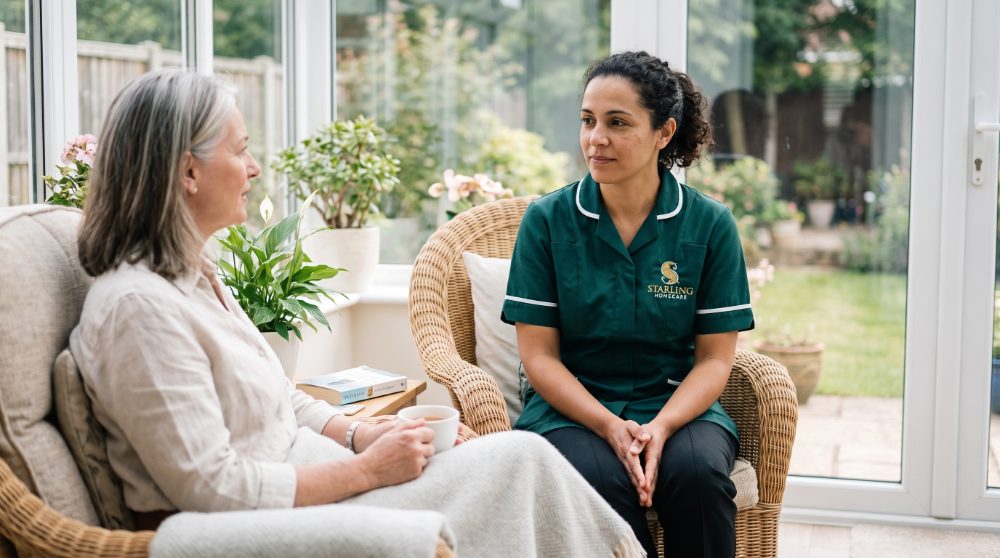
MS respite care is a planned break for the person who does the caring. Someone else looks after the person with MS for a few hours, a night or longer. Families in Hertfordshire often search for "MS respite care homes", because that is the form they assume it takes.
In practice, most of the breaks we arrange for MS happen at home. For a condition that changes from week to week, that is usually the better fit.
This piece is for the husband, wife, son or daughter who has been the carer for a long time and has not had a day off. It explains what MS respite care can look like and what Hertfordshire will fund. It also covers where the MS charities fit, and what to settle before the first break so that it works.
Starling Homecare is a family run, CQC registered provider. MS respite care at home is part of our MS care at home service across Hertfordshire. Nothing here is medical advice; the MS nurse and the neurologist stay in charge of the condition itself.
What MS respite care actually is
The MS Trust describes respite as short-term, temporary support. It lets people with MS, and the family members who look after them, have a break and some time to themselves. A trained care worker can give it at home for a few hours in the daytime or overnight, staying while the carer is out.
Alternatively, it can be a day centre, or a short residential stay in a care home or hospice.
The MS Society makes the same point, too. Respite can take place in your own home, on holiday, or in a specialist centre, nursing home or care home. The search term suggests one option; the reality is three.
Why respite at home suits MS
MS does not run to a timetable. Fatigue, a relapse or simply a bad week can change what someone needs between booking a break and taking it. A residential respite bed needs booking weeks ahead for a fixed stay.
Care at home, by contrast, fits around the person and can move.
There is a second reason, which the MS Society names plainly. Finding a respite centre that will take someone with a particular type of need can be a challenge. At home, the room, the equipment, the routine and the medicines are already in place.
The carer who comes in learns them, rather than the person having to fit a new building.
Then there is the person themselves, of course. Someone with advanced MS may need round the clock support, as the MS Trust notes. Being moved for a week can cost more than the week gives back.
In other words, a break for the carer should not become a disruption for the person.
How MS respite care at home works with Starling Homecare
We start with the carer, not the rota. What would you do with a Wednesday afternoon, a full night's sleep or a weekend away? We then design the break backwards from that answer.
Then we build the cover around the person's real day. When is fatigue worst, when are medicines due, how are transfers done and with what equipment? What does a good day look like, and a bad one?
Before the first break, the carer covering it meets the person and the family carer. Where the break is regular, it is the same carer each time.
In practice it takes three forms: a few hours on the same afternoon each week, an overnight so the family carer sleeps, or a longer block of days covered by a live-in carer when the family carer goes away.
Support can step up during a relapse and step back afterwards. Our county guide to respite care in Hertfordshire describes the same pattern for other conditions.
What Hertfordshire will fund
Hertfordshire County Council funds up to 12 hours of free short breaks for unpaid carers of an adult. The breaks last two to three hours each, in the home or the local community. Outside North Herts and Stevenage the service is run by Care By Us, and in North Herts and Stevenage by Crossroads Caring for Life.
In other words, it is short-term support, and it is free.
For longer-term breaks the route is a free carer's assessment from the council. If the assessment identifies a need, the council may arrange ongoing carers breaks. It may instead make direct payments so that you arrange your own.
Importantly, the council states that these services are free for carers and do not need a financial assessment.
The person with MS may also qualify for support in their own right. That comes through a care needs assessment and, in some cases, through NHS continuing healthcare. We have written separately about care needs assessments in Hertfordshire, including how to ask for one.
The MS charities on your doorstep
Hertfordshire is unusually well placed. The MS Trust is based in Letchworth Garden City, and its helpline on 0800 032 38 39 covers care and respite questions. The MS Society runs an MS Short Breaks Service to help plan a break or find respite care.
You reach it through the MS Help team on 0808 800 8000. That team can also put you in touch with the nearest carers group, who will know which local respite has worked for others.
Also in Letchworth is the Herts MS Therapy Centre, for example. It is a charity founded by a local resident, and it has run oxygen therapy sessions for people with MS since 1983. Whether it is right for someone is a question for their MS team.
It is, though, one of the places where people living with MS in the county meet each other.
Where we provide MS respite care
Our carers provide MS respite care across all ten of the areas we cover. Each has its own local team and its own number.
- St Albans: 01727 324 127
- Harpenden: 01582 824 830
- Welwyn Hatfield: 01707 714 000
- Potters Bar: 01707 714 000
- Radlett and Shenley: 01923 988 550
- Hemel Hempstead: 01442 954 137
- Berkhamsted: 01442 954 137
- Tring: 01442 954 137
- Hitchin: 01462 534739
- Hertford: 01920 746779
Common questions about MS respite care
Does Starling Homecare provide MS respite care in Hertfordshire?
Yes. Starling Homecare is a family run, CQC registered home care provider, and MS respite care at home is part of our MS service across Hertfordshire. It can be a few hours a week, an overnight or a longer block covered by a live-in carer.
Each follows the person's own pattern of fatigue and relapse.
Is MS respite care free?
Some of it can be. First, Hertfordshire County Council funds up to 12 hours of free short breaks for unpaid carers. A free carer's assessment can lead to ongoing breaks or direct payments, with no financial assessment.
Beyond that, families arrange and pay for respite at home privately, or through those direct payments.
Can respite cover a relapse rather than a planned break?
Yes. In fact, a relapse is often when the family carer most needs cover. Care at home can step up for the weeks it lasts and step back afterwards.
That is far easier to arrange at home than as a residential stay, which needs booking ahead for fixed dates.
A break that survives the condition
The right MS respite care is the one that still happens when the week goes wrong. For most families in Hertfordshire that means cover at home, from a carer who already knows the person. Use the council's free hours first, and then have a plan for the relapse nobody wanted.
Our head office is on 01727 324 127, or you can use the number for your own area above.
The MS Trust respite page, the MS Society breaks and holidays page and the Hertfordshire County Council carers breaks page were checked on 16 September 2026. This article is general information, not medical advice.
Arranging Care Is Simple
Starting care can feel like a big step. We keep it calm and straightforward, and we are here to guide you from your very first call.
1. Talk to us
Get in touch by phone or request a callback. We will listen, answer your questions and help you understand the options, so you can decide what feels right in your own time.
2. A home visit and initial consultation
We arrange a visit to understand your routines, your home and what matters most to you. Together we agree an initial consultation and shape the support that feels right.
3. Your care begins
A small, familiar team starts your care, arriving at the agreed times and staying involved as your needs change. We remain your trusted adviser throughout.
Whenever you are ready, we are here to help.