
If you are worried about a parent living alone in St Albans, the most useful question is not whether they are coping. It is how long it would be before anyone knew if they were not.
That question tends to settle everything else: how often someone should call in, at what times of day, and what the visit is actually for. It is also the question families find hardest to ask out loud.
Most of the people we support who are living alone are managing, mostly. The difficulty is rarely the ordinary day. It is the day that goes wrong when there is nobody else in the house.
Why living alone in St Albans changes the exposure, not the need
Someone living alone in St Albans may need very little practical help. What changes is what happens when something does go wrong.
A person living with a partner has somebody who notices the missed meal, the new bruise, the confusion that was not there last week. Living alone removes that quiet monitoring, and in our experience it is the monitoring, rather than the tasks, that families are really worried about.
That is worth saying plainly, because it changes what you are shopping for. You may not need much help. You may need somebody to notice.
What a fall looks like when nobody is in the house
The NHS advises anyone who has fallen and cannot get up to use a phone or personal alarm if they can reach one, try to attract attention by shouting or banging on a wall, keep warm, keep moving, and change position about every thirty minutes to help prevent pressure sores.
Read that guidance again and notice what it assumes. It assumes a wait.
For someone living alone in St Albans, the length of that wait is not a matter of luck. It depends on who calls round, and when. That is one of the few things in this situation a family can genuinely decide.
The gaps between visits are what to look at when someone is living alone in St Albans
When families ask how many care visits someone living alone in St Albans needs, they are usually thinking about tasks. We tend to start with the shape of the day instead.
With a single morning call, someone sees your mother at nine and then nobody does until the following morning. Two calls, morning and early evening, roughly halve the longest unobserved stretch. Neither pattern is right or wrong, but they answer different worries.
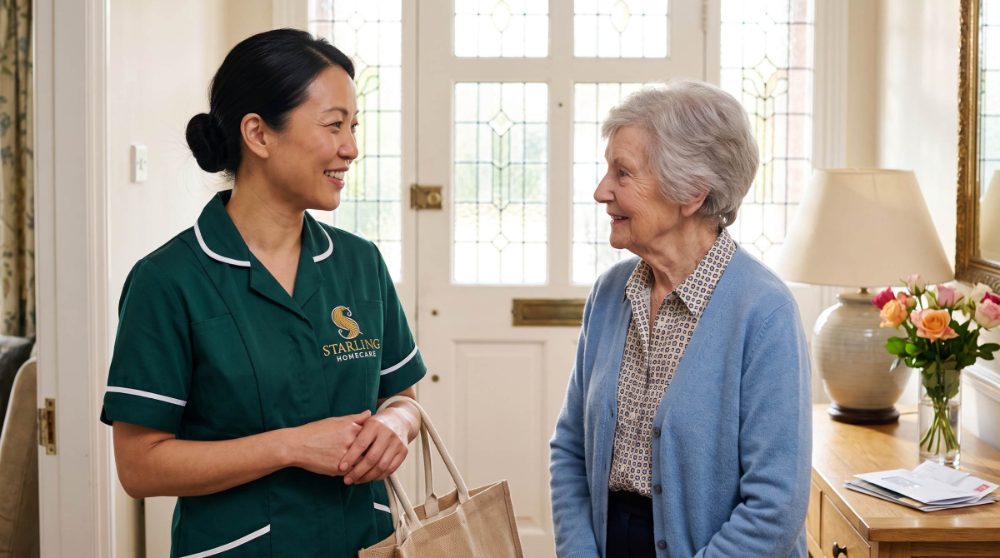
The other half of it is continuity. The same carer, coming regularly, is the person who notices that your mother is slower on the stairs than she was a fortnight ago. A different face each visit cannot do that, however skilled they are, which is why we build rotas around continuity rather than convenience.
If you would like to think through what a sensible pattern looks like, our St Albans team is on 01727 324 127.
What we tend to notice on a first visit
Some of it is obvious and some of it is not.
Post stacking up unopened, or food in the fridge well past its date, says something about how the week is going. So does whether she still uses the upstairs, or whether a chair downstairs has quietly become the bed.
The NHS falls guidance points at the practical things too: shoes and slippers that fit well and grip properly, no loose rugs or trailing wires to trip on, and a word with a GP or pharmacist if any medicine might be affecting balance. It also lists what raises the risk in the first place, including muscles weakening with age, eyesight and hearing changes, low blood pressure, and conditions such as arthritis, stroke, Parkinson's disease or dementia.
We are not a clinical service and we do not diagnose anything. What we do is see the house as it actually is, week after week, and that is often what tells the story.
Free help worth using before you pay for anything
Two things cost nothing and both are underused.
Anyone can ask their council for a care needs assessment, and it is free. It looks at what help a person needs, including changes that would make the home safer. Our guide to care needs assessments in Hertfordshire explains how to ask and what to expect.
HertsHelp is a free, independent information and advice service for anyone living in Hertfordshire, funded by Hertfordshire County Council and NHS partners, on 0300 123 4044. Age UK also runs a free advice line on 0800 678 1602, open 8am to 7pm every day. Neither will try to sell you care.
Living alone in St Albans, and where we work
We support people across the city and the streets around it, and a good deal of our St Albans work sits on the Sandridge, Marshalswick and Jersey Farm side, along with Redbourn and the city centre.
If everyday practical help is the gap, our home care in St Albans explains what a visiting service covers. Where the worry is more about company and the shape of the week than about tasks, companionship care in St Albans is likely to be closer to it. Both sit on the same foundation, our personal care service, and a conversation about what the days genuinely look like.
Common Questions About Someone Living Alone in St Albans
How often should someone living alone in St Albans have a care visit?
There is no standard answer, and anyone who offers one without asking about the person is guessing. In our experience the useful question is the longest stretch you are comfortable with nobody seeing them. Once you settle that, the number of visits tends to follow on its own.
Is a personal alarm enough on its own?
An alarm is genuinely worth having, and the NHS suggests wearing one or carrying a mobile phone. An alarm only helps if someone actually wears it and can reach and use it after a fall. It answers the emergency. What it cannot do is notice the slow decline in the weeks before one.
What if my parent says they do not want help?
This is the most common thing families bring to us, and it is rarely stubbornness. It is usually about not wanting to be managed. Starting small, with one regular visit that has an obvious and limited purpose, tends to work far better than arriving with a plan for everything.
Somebody living alone in St Albans does not have to give up their independence to be safer. Most of the time it takes one honest conversation about the gaps, and then a pattern of support that fits the person rather than the worry. If you would like to talk it through with someone who does this every day, our St Albans team is on 01727 324 127 or [email protected]. We are registered with the Care Quality Commission.
We checked NHS guidance on falls, including what to do after a fall and how to reduce the risk, on 19 August 2026.
If it would help to see how we work locally, you can read more about home care in St Albans.
Arranging Care Is Simple
Starting care can feel like a big step. We keep it calm and straightforward, and we are here to guide you from your very first call.
1. Talk to us
Get in touch by phone or request a callback. We will listen, answer your questions and help you understand the options, so you can decide what feels right in your own time.
2. A home visit and initial consultation
We arrange a visit to understand your routines, your home and what matters most to you. Together we agree an initial consultation and shape the support that feels right.
3. Your care begins
A small, familiar team starts your care, arriving at the agreed times and staying involved as your needs change. We remain your trusted adviser throughout.
Whenever you are ready, we are here to help.