
The Attendance Allowance special rules let someone who may have twelve months or less to live claim faster, and at the higher rate. There is no six month wait for help to have been needed first. A doctor or nurse completes a short form called an SR1, nobody attends an assessment, and the award is the higher rate of £114.60 a week.
That is the whole of the rule. What makes the Attendance Allowance special rules hard is the moment they arrive in.
Families reach this page after a conversation with a consultant or a hospice nurse that has changed everything. The last thing anyone wants to do that week is fill in a benefits form. But this form is short and quick. The money it releases usually goes straight into keeping someone comfortable at home, so it is worth doing early rather than late.
This guide sits under our main Attendance Allowance guide. It answers one question only: how the special rules work, and how to use them in Hertfordshire. We checked every rule below against GOV.UK on 19 September 2026.
What the Attendance Allowance special rules actually change
Under the ordinary rules, Attendance Allowance goes to someone over State Pension age who has needed help with personal care or supervision for at least six months. There are two rates. Which one you get depends on whether you need help in the day, at night, or both.
The special rules remove the waiting and the grading. GOV.UK describes them as a route to getting Attendance Allowance "more quickly and at a higher rate". The medical form decides the claim, rather than a long description of daily needs.
Three things follow from that. First, the six month qualifying period does not apply. Second, the higher rate follows automatically. Third, nobody has to attend an assessment.
Who qualifies under the Attendance Allowance special rules?
Two conditions apply under the Attendance Allowance special rules, and both come from GOV.UK. The person has reached State Pension age. In addition, a doctor or medical professional has said they might have twelve months or less to live.
The twelve months is not a test the family has to pass. GOV.UK says plainly that predicting how long someone might live is difficult. If a medical professional has not raised it, you can still ask whether they will support a claim under the special rules. The professionals who can do this include GPs, consultants, specialty doctors, hospice doctors and registered nurses, which covers Macmillan and other specialist nurses.
In our experience the hospice or palliative care team is usually the quickest route. They complete these forms often, and they know what the Department for Work and Pensions needs to see.
How do you claim under the Attendance Allowance special rules?
There are two parts, and they can happen in either order. In practice most families do them in the same week.
First, ask a medical professional for form SR1. They either complete it and send it straight to the Department for Work and Pensions, or complete it and hand it to you to send. Importantly, only a medical professional can access the form. One SR1 covers every benefit under the special rules, so a person claiming more than one benefit still needs only one form.
Second, apply for Attendance Allowance itself. You can do this online through GOV.UK, which has a specific special rules route, or by post using the standard claim form. You can apply on someone else's behalf without their permission, which matters when the person is too unwell to deal with it themselves.
For the online application you will need four things. The person's National Insurance number, their address and contact details, the name of their GP surgery, and details of any hospital, hospice or care home they are staying in.
What happens after you apply, and when is it paid?
GOV.UK says the Department will contact you by phone or letter within three weeks to explain when to expect a decision. The decision letter itself will not mention the special rules, which sometimes worries families who expected to see the words. Instead, the higher rate is the confirmation.
The start date depends on how you applied. For example, an online claim starts on the day you make it. A posted form starts on the day the Department receives it. If you rang the helpline for a form, the claim starts on the date of the call, as long as the form goes back within six weeks. The helpline is 0800 731 0122, Monday to Friday, 8am to 6pm.
Attendance Allowance is not means tested, so savings and income do not reduce it. It can also increase Pension Credit, Housing Benefit or Council Tax Reduction. So it is worth telling whoever pays those benefits once the award comes through.
If Attendance Allowance is already in payment
Some people already receive Attendance Allowance at the lower rate when a doctor tells them they may have twelve months or less to live. GOV.UK asks them to contact the helpline straight away. The claim can then move to the higher rate under the Attendance Allowance special rules, instead of waiting for a change of circumstances review, so the higher rate starts sooner.
In our experience this is one of the steps most often missed. The family assumes the benefit is sorted because it is already in payment, and the increase never happens.
Who can help with an SR1 claim in Hertfordshire
Where the diagnosis is cancer, Macmillan Money and More for the East of England offers benefits advice and help with forms and evidence. Hertfordshire County Council runs it in partnership with Macmillan. The quickest route in is the online referral on their website, and a professional can refer on your behalf.
For any diagnosis, Hertfordshire County Council's Money Advice Unit publishes benefits information through the council's money advice pages. Meanwhile, Citizens Advice remains the general route for help with a claim. The hospice teams that come to the home across the county often have their own welfare advisers as well. We describe those teams in our guide to end of life care at home in Hertfordshire.
How care at home fits alongside an Attendance Allowance special rules claim
The higher rate is £114.60 a week, and it goes to the person, not to a service. Most of the families we support at this stage put it towards visiting care. As a result, a regular carer covers washing, dressing, medication prompts and meals, and the family can simply be family.
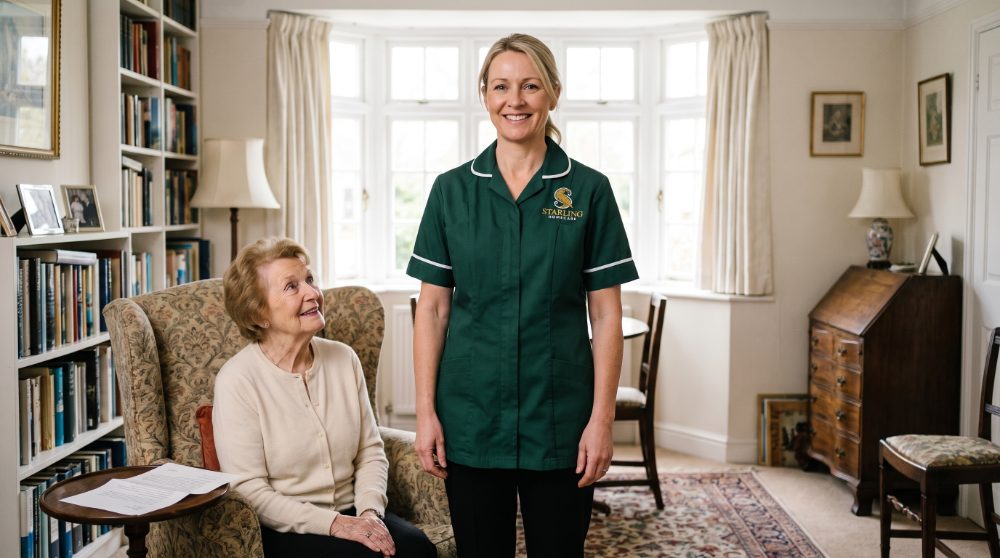
Starling Homecare is a family run, CQC registered provider. Our end of life care at home works alongside the district nurses and hospice teams rather than in place of them. Visiting care with us starts from £34 an hour and is VAT exempt. When time matters, we can usually start within days.
Common questions about the Attendance Allowance special rules
Do you have to have needed help for six months to claim under the special rules?
No. The six month qualifying period belongs to the ordinary rules. Under the special rules for end of life, the test is State Pension age plus a medical professional's view that the person may have twelve months or less to live. GOV.UK describes the claim as quicker and at the higher rate.
Which rate of Attendance Allowance do you get under the special rules?
The higher rate, £114.60 a week as at September 2026. In other words, it is the same rate as for someone who needs help day and night under the ordinary rules, and it is not means tested.
Can a family member make the special rules claim without the person knowing?
Yes. GOV.UK states that someone else can make the claim and does not need the person's permission. The decision letter does not mention the special rules. So a person who has not heard their prognosis in detail will not learn it from the award.
We checked these figures against GOV.UK: claiming Attendance Allowance if you're nearing the end of life and GOV.UK: get benefits if you're nearing the end of life on 19 September 2026. Benefit rates normally change each April. To talk through how care at home could work alongside the claim, our St Albans office is on 01727 324 127 or [email protected].
Arranging Care Is Simple
Starting care can feel like a big step. We keep it calm and straightforward, and we are here to guide you from your very first call.
1. Talk to us
Get in touch by phone or request a callback. We will listen, answer your questions and help you understand the options, so you can decide what feels right in your own time.
2. A home visit and initial consultation
We arrange a visit to understand your routines, your home and what matters most to you. Together we agree an initial consultation and shape the support that feels right.
3. Your care begins
A small, familiar team starts your care, arriving at the agreed times and staying involved as your needs change. We remain your trusted adviser throughout.
Whenever you are ready, we are here to help.