
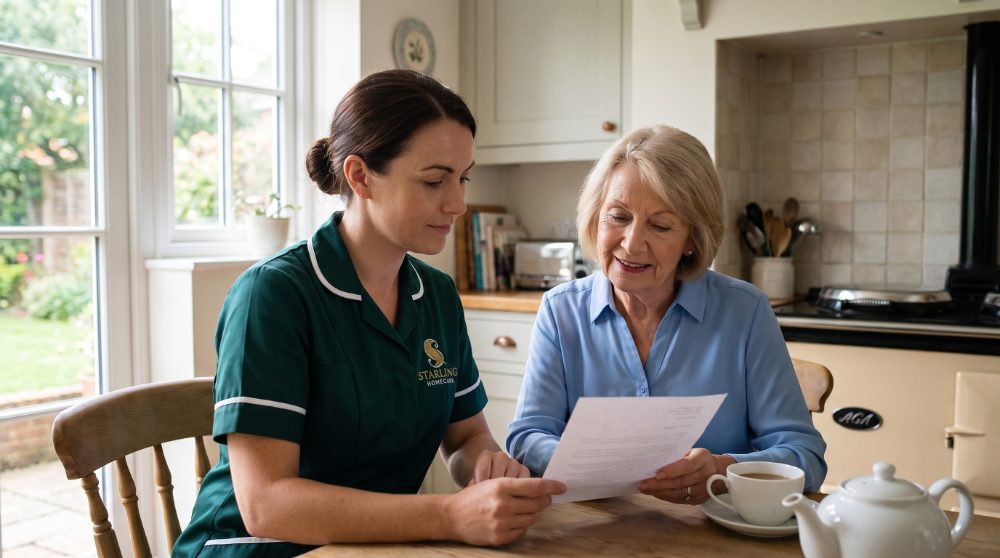
An Attendance Allowance appeal starts with a mandatory reconsideration, not a tribunal, and it must usually be asked for within one month of the decision letter. It is free at every stage. This guide sets out the GOV.UK process in order, what to send, and when the tribunal comes into it.
A refusal letter rarely feels like the start of a process. It reads like an ending. Families we support across Hertfordshire often put the letter aside for a few days before they can face it, which is understandable, but the one-month clock is already running.
Everything below comes from GOV.UK, checked on 25 September 2026. Nothing here is legal advice: it sets out the official process so you know what is coming and can ask for help with confidence.
Starting an Attendance Allowance appeal: ask for a mandatory reconsideration first
You cannot go straight to a tribunal. GOV.UK is clear that the first step in challenging any Attendance Allowance decision is to ask the Department for Work and Pensions to look at it again, called a mandatory reconsideration.
The request needs to reach them within one month of the date on the decision letter. A later request is still possible with a good reason, hospital admission or a bereavement are the examples GOV.UK gives, but the number on the decision letter is the one to call first if that applies.
There is no fee. The contact details for asking are printed on the decision letter itself, because the office that made the decision is the one that reconsiders it.
What to send with the request
GOV.UK asks for the same core details every time: the date of the original decision, full name and address, date of birth and National Insurance number, plus a plain explanation of which part of the decision is wrong and why.
New supporting evidence helps, provided it speaks directly to the disagreement rather than repeating what was already sent. GOV.UK gives medical reports and care records as examples, each one marked with name, date of birth and National Insurance number so it can be matched to the file.
A request by phone or letter is enough; there is no requirement to use a solicitor or a paid adviser to ask for a reconsideration.
If the decision does not change
The DWP sends a mandatory reconsideration notice explaining the outcome, whether or not it changes anything. That notice is the document the rest of the process turns on, so it is worth keeping safely with the original decision letter.
If the reconsideration keeps the original decision and you still disagree, the next and final route is an appeal to the Social Security and Child Support Tribunal, an independent body run by HM Courts and Tribunals Service, separate from the DWP entirely.
GOV.UK is specific about the clock here too: the appeal has to reach the tribunal within one month of the date on the mandatory reconsideration notice, using form SSCS1, either online or by post, with the notice itself attached as evidence.
What happens at the tribunal
Appealing is also free. GOV.UK states plainly that it costs nothing to appeal a benefit decision.
You choose whether to attend the hearing in person or let the tribunal decide from the appeal form and the written evidence alone. Attending in person is generally the stronger option where the case turns on how a condition affects day-to-day life, since a panel can ask questions a form cannot.
If the tribunal's decision still is not right, GOV.UK sets out two further routes: asking for the decision to be set aside on a factual error, or appealing to the Upper Tribunal on a point of law. Both are narrower steps than the first appeal and are usually worth discussing with an adviser before they are used.
Getting help with the appeal itself
Starling Homecare is a CQC-registered homecare provider, not a benefits adviser, so we do not complete appeal forms or represent a family at a tribunal. What we can say, from arranging care for families across Hertfordshire going through this exact process, is that free, specialist help exists and is worth using.
Citizens Advice and Age UK both support people through mandatory reconsiderations and tribunal appeals at no cost, and a local welfare rights team can often help gather the right medical evidence. None of this needs to wait for arranging later life care at home, which can start, pause or continue at whatever pace suits the family while a claim is being decided.
Common questions about appealing an Attendance Allowance decision
How long does a mandatory reconsideration take? GOV.UK does not publish a fixed timescale, since it depends on how much new evidence needs checking. Keeping a note of when the request was sent, and following up if a decision has not arrived within a few weeks, is sensible.
Can a family member or friend help with the appeal? Yes. Nothing on GOV.UK stops a family member, friend or adviser helping to write the request or attending the tribunal hearing alongside the claimant; the claimant simply needs to be comfortable with who is helping and what is being said on their behalf.
Does an appeal affect an existing Attendance Allowance payment? Appealing a decision to reduce or refuse an award does not itself create a new payment while the appeal is open. If a payment was already in place and is under review, it is worth asking the office named on the decision letter exactly what changes and when, since this varies by case.
A turned-down claim is a decision, not the final word, and GOV.UK lays out exactly how to challenge it, free, in order, with clear time limits at each stage. Our guide to claiming Attendance Allowance covers the process from the other side, for anyone starting a first claim or a fresh one after this one is resolved. If you are arranging care at home anywhere in Hertfordshire while a claim is being decided, our team is happy to talk through what that could look like, on 01727 324 127 or at [email protected].
Arranging Care Is Simple
Starting care can feel like a big step. We keep it calm and straightforward, and we are here to guide you from your very first call.
1. Talk to us
Get in touch by phone or request a callback. We will listen, answer your questions and help you understand the options, so you can decide what feels right in your own time.
2. A home visit and initial consultation
We arrange a visit to understand your routines, your home and what matters most to you. Together we agree an initial consultation and shape the support that feels right.
3. Your care begins
A small, familiar team starts your care, arriving at the agreed times and staying involved as your needs change. We remain your trusted adviser throughout.
Whenever you are ready, we are here to help.