
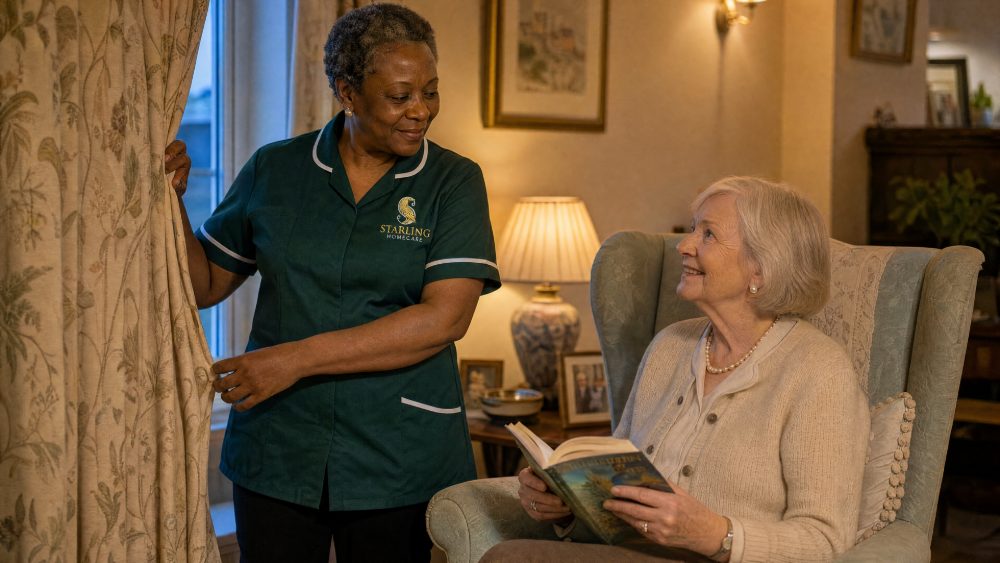
When people search for 24 hour care in Hitchin, they usually mean one thing: someone needs to be there, day and night. The best way to choose how that cover is arranged is to look closely at the nights first, because the nights decide most of the rest. This guide walks through the questions we ask families, a short checklist, and what the first fortnight tends to look like.
Why the nights shape 24 hour care in Hitchin
Round-the-clock care at home can be put together in a few ways. A live-in carer can stay in the home. Daytime visits can be paired with a waking night carer, who stays awake all night, or a sleeping night carer, who rests in the home and helps if needed.
For heavier needs, a small team of carers can work in shifts. Age UK's Finding help at home factsheet notes that it is possible to arrange 24-hour live-in carers, for example through a care agency. Which arrangement suits your mum, dad or partner depends far more on what happens after dark than on the daytime routine.
Five questions to ask about the nights
Spend a few nights noticing what actually happens, or ask whoever is currently there. A rough diary is more useful than a memory of one bad night.
How often is help needed? Once in a while is very different from every hour or two. A live-in carer needs proper sleep to be safe and kind the next day, so frequent waking points towards a waking night carer or shifts.
Do they wander or try to go out? Someone who gets up confused and heads for the front door needs a person awake and alert. This is one of the clearest signs that a sleeping arrangement will not be enough.
Does turning or moving in bed need two people? If repositioning has been assessed as a two-person task, the night plan has to provide two people at those times. One carer on their own cannot cover it.
Are there trips to the toilet? One assisted trip a night can often sit within live-in care. Several trips, or a risk of falls on the way, usually call for a waking carer.
Are the nights anxious? Some people simply feel safer knowing a familiar voice is nearby. Reassurance and a calm routine at bedtime can make a real difference, and that kind of support suits most arrangements.
Then look at the days, the house and the family
Once the nights are clear, the daytime picture fills in quickly. Does the person need someone with them all day, or are there settled stretches between meals, personal care and appointments?
The house matters too. A live-in carer needs a bedroom of their own and somewhere to rest during their breaks. In a smaller home in Ickleford or a cottage in Great Offley, a spare room is sometimes the deciding factor.
Finally, think about your own role. Some families want to keep certain evenings or weekends for themselves, and a plan can be built around that. Others are already exhausted and need the care to cover everything.
A short checklist before you call anyone
- A week of notes on the nights: times up, why, and how long it took to settle.
- A list of daytime tasks, from washing and dressing to meals and medication prompts.
- Whether there is a spare bedroom a carer could use.
- Upcoming appointments and who will take them.
- What the family wants to keep doing, and what you need to step back from.
- Any advice already given by the GP or hospital team.
The NHS guide to homecare also suggests asking an agency what charges apply, which services count as extras and how they choose a carer. It notes that all homecare agencies must register with the Care Quality Commission. You can look up any provider's latest inspection report and rating on the CQC website.
The first fortnight of round-the-clock care
The first two weeks are about learning, not getting everything perfect. In the early days we visit, meet the family and agree a care plan that sets out the night routine as clearly as the daytime one.
During the first week, the carer gets to know how the person likes to settle, what wakes them and what helps them back to sleep. We write that down so every carer works the same way. If a night arrangement turns out to be too light or too heavy, it is far better to adjust in week one than to carry on.
By the second week, most families have a feel for whether the mix is right. Appointments are a good test of the routine. If one falls at the Lister, the hospital trust's update on the county council's mobility hub works says access for patients and visitors is being maintained, but asks people to allow extra time for journeys, with the work expected to complete in November 2026.
This is also a good time to look after yourself. Carers in Herts runs a Hitchin hub at Christchurch, Bedford Road, on Monday 2 November 2026 from 1pm to 2.30pm, where carers can meet others and share information. Their event page has a booking form, and their number is 01992 58 69 69.
How we arrange 24-hour care in Hitchin
Our Hitchin team is local, and we keep the group of carers around each person small so faces stay familiar. Depending on the nights, we can arrange a live-in carer, daytime visits with night support, or a combination. You can read more on our live-in care service page and our care in Hitchin area page.
If the nights are the main worry, our guide to overnight care in Hitchin goes into more detail. For families leaning towards one carer living in, see live-in care in Hitchin.
Live-in care starts from £255 a day and visiting care from £34 an hour. These are starting rates, and a price is agreed after an assessment of what the days and nights involve. You can reach the Hitchin team on 01462 534739 or at [email protected].
Common questions about 24 hour care in Hitchin
Can one live-in carer cover the nights as well?
Often, yes, if the nights are mostly quiet with the odd call for help. A live-in carer needs a proper night's sleep, so regular waking usually means adding night support. We look at this carefully during the assessment.
What is the difference between a waking and a sleeping night carer?
A waking night carer stays awake and alert all night. A sleeping night carer rests in the home and is there if help is needed occasionally. The right choice depends on how often the person needs someone during the night.
Do we need a spare room?
For live-in care, yes, the carer needs their own bedroom. Without one, daytime visits with night support, or a shift team, may be the better fit. We can talk through what works in your home.
How do we check a care provider?
Homecare agencies providing personal care must register with the Care Quality Commission. The CQC website lets you search for a provider and read its inspection reports and ratings. It is worth asking any agency about charges and how carers are chosen, too.
Getting the nights right tends to settle everything else. Once you know what happens after dark, the choice between live-in care, night support or shifts becomes much clearer, and the plan can be adjusted as needs change.
Details checked against the NHS guide to homecare, Age UK's Finding help at home factsheet, the CQC website, Carers in Herts and East and North Hertfordshire NHS Trust on 12 October 2026. Our prices are starting rates, checked on the same date.
Arranging Care Is Simple
Starting care can feel like a big step. We keep it calm and straightforward, and we are here to guide you from your very first call.
1. Talk to us
Get in touch by phone or request a callback. We will listen, answer your questions and help you understand the options, so you can decide what feels right in your own time.
2. A home visit and initial consultation
We arrange a visit to understand your routines, your home and what matters most to you. Together we agree an initial consultation and shape the support that feels right.
3. Your care begins
A small, familiar team starts your care, arriving at the agreed times and staying involved as your needs change. We remain your trusted adviser throughout.
Whenever you are ready, we are here to help.