
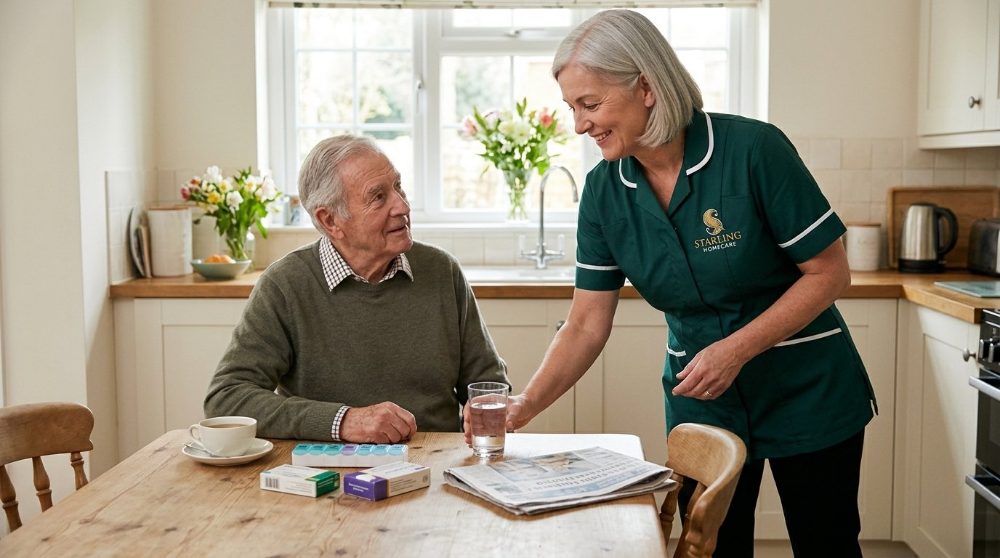
Medication support at home in Hitchin means a trained carer helping an older person take the right medicines at the right times, safely and without fuss. For families, it turns a daily source of worry into a steady routine that someone dependable is quietly keeping.
Medicines have a way of multiplying in later life. A repeat prescription here, a new tablet after a hospital stay there, and before long the kitchen shelf holds eight boxes with different instructions.
The strain this creates is real but rarely talked about. Research funded by the National Institute for Health and Care Research found that managing medication places a heavy, often hidden burden on older people and the relatives who help them, and that medication-related harm costs the UK an estimated 750 million pounds a year. We support families across Hitchin with exactly this, and nobody rings us about one tablet a day. It is the growing list, and the growing doubt about whether it is being taken properly, that prompts the call.
When does a medicines routine start to slip?
The signs are usually small before they are serious. Boxes still sealed at the end of the week, a pill organiser with Tuesday empty but Thursday untouched, or doses doubled up to catch up after a missed morning.
A hospital stay is a common turning point. Prescriptions often change at discharge, and a routine that worked for years can unravel in a fortnight because the names, colours and times are suddenly different.
If you are keeping an eye on a parent from a distance, you may only spot the gaps when you visit. In our experience, that uncertainty is the right moment to arrange support, before there is a real mistake to recover from.
What does a dose-time visit look like?
Visits are planned around dose times, not the other way round. If the important medicines are due at eight in the morning and six in the evening, those are the visits we build the day around.
The help itself is matched to the person. For some, it is a friendly reminder and a glass of water. For others, the carer prepares the medicines from their packaging and stays while they are taken. Our guide to medication management at home explains the different levels of support and how the right one is agreed.
Around the doses, a carer keeps the practical side moving as part of our wider medication management support: ordering repeat prescriptions in good time, collecting them from the pharmacy or arranging delivery, and making sure the supply never quietly runs out over a weekend.
How does medication support at home in Hitchin stay safe?
Everything rests on a written plan agreed at the start. It records which medicines are taken, what help the carer gives with each one, and what should happen if a dose is missed or refused.
Carers are trained and competency checked before they support anyone with medicines, and they complete a record at every visit. Families can see at a glance what was taken and when, which is often the single biggest relief.
None of this is guesswork. NICE, the National Institute for Health and Care Excellence, publishes guidance on managing medicines for adults receiving social care in the community, and as a CQC registered provider we work to that standard.
How do carers work with the GP surgery and pharmacy?
A long list of medicines should never be managed in isolation. The GP can carry out a medication review when the list feels unwieldy, and the pharmacist is a helpful voice on timing and on how different medicines sit together.
A carer who visits regularly adds the missing piece: eyes on how things are actually going. Drowsiness, dizziness or a change in appetite gets noticed, written down and shared with the family, and with the surgery where that is agreed.
Because our carers are local, dose-time visits work wherever someone lives, in the town centre or in the villages around Hitchin such as Walsworth, Ickleford or Gosmore.
How do you arrange medication support in Hitchin?
It starts with a conversation and a home visit, so the plan reflects how the person genuinely lives rather than just what the prescription list says. Many families begin with short dose-time visits and let the support settle in from there.
Medication support often sits within wider help at home, from personal care to a hand with meals, and our Hitchin team can shape the visits around both.
Common Questions About Medication Support at Home in Hitchin
Who decides how much help a carer gives with medicines?
The level of support is agreed between the person, their family and us when the care plan is written, and it is recorded clearly. It ranges from prompting and reminding through to administering medicines where that is fully agreed, and it is never improvised on the day.
How do we know which medicines have actually been taken?
The carer completes a medication record at every visit. Anything missed, refused or unusual is noted and flagged to the family the same day, so nothing sits unnoticed until the next visit.
What happens when prescriptions change after a hospital stay?
The care plan is updated straight away. The new list is confirmed with the GP surgery and the pharmacy, medicines that are no longer prescribed are set aside for safe return, and the first days on a new routine are given extra attention.
A growing list of medicines does not have to mean a growing worry. With a clear plan, a trained carer and a good routine, it becomes one more part of the day that simply works. If it would help to talk it through, our Hitchin team is on 01462 534739 or at [email protected].
Arranging Care Is Simple
Starting care can feel like a big step. We keep it calm and straightforward, and we are here to guide you from your very first call.
1. Talk to us
Get in touch by phone or request a callback. We will listen, answer your questions and help you understand the options, so you can decide what feels right in your own time.
2. A home visit and initial consultation
We arrange a visit to understand your routines, your home and what matters most to you. Together we agree an initial consultation and shape the support that feels right.
3. Your care begins
A small, familiar team starts your care, arriving at the agreed times and staying involved as your needs change. We remain your trusted adviser throughout.
Whenever you are ready, we are here to help.