
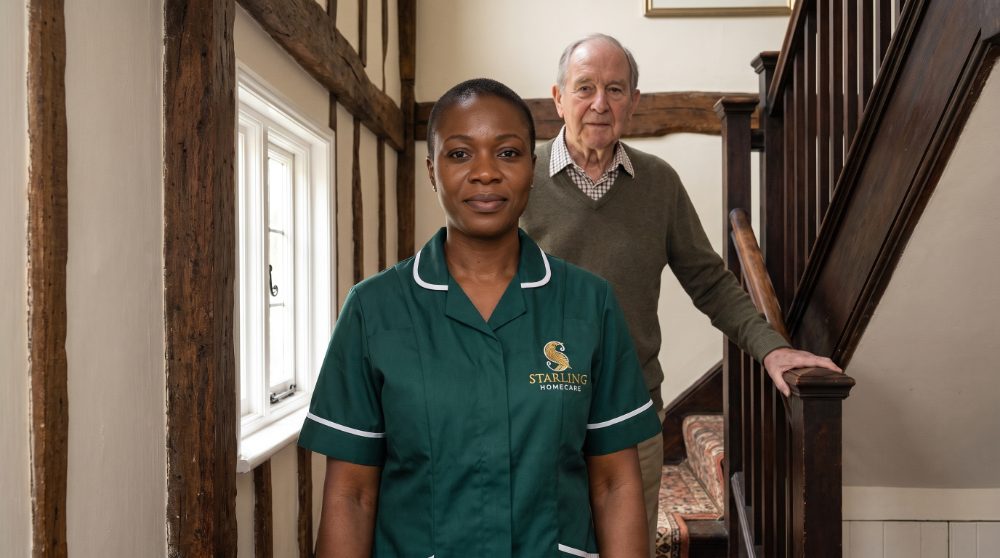
Home care in Old Hatfield usually has to work around the house rather than change it. The old town sits in a conservation area and much of its stock is period. A good deal of it was never laid out for someone who cannot manage stairs.
Brookmans Park and Welham Green, a few miles south, present the same problem in a different decade.
This piece is about designing the care instead of rebuilding the house. It covers what a carer actually works around in an older property. It also covers the decision most families face about upstairs, and what to settle before the first visit.
Starling Homecare is a family run, CQC registered provider. Our Welwyn Hatfield team looks after Old Hatfield, Brookmans Park and Welham Green from one office. The number is 01707 714 000.
Why home care in Old Hatfield starts with the house
Hatfield is really two towns. The post-war new town spreads west of the railway. It was built with level access and downstairs cloakrooms as a matter of course.
Old Hatfield, up by the church and the gates of Hatfield House, was not.
Welwyn Hatfield Borough Council lists the Old Hatfield historic core among the borough's ten conservation areas. Historic England records Grade II listed buildings on Fore Street itself.
Brookmans Park and Welham Green are newer, mostly inter-war commuter housing. Even so, they share the pattern that matters: bedroom and bathroom upstairs, and a narrow staircase between.
So the honest starting point for home care in Old Hatfield is not what could be altered. It is what can be done well on Tuesday.
What a carer works around in an older house
Four things come up again and again, and none of them is dramatic. The bathroom is upstairs, so washing means a journey rather than a room. Doorways are narrow, so a frame or a wheeled walker does not turn easily.
Floors change level between rooms. And the rooms furthest from the boiler are genuinely cold by February.
A carer who has worked in this kind of house plans around all four without being asked. She will bring what is needed upstairs in one trip rather than three. She will do a full wash at the basin when the trip to the bath is the risk.
In our experience that is the difference between a visit that works and a visit that runs late. It is also the thing to ask a provider about directly: have your carers worked in houses like this one?
The upstairs decision
Sooner or later most families in these houses face the same question. Do you move the bed downstairs, or keep the bedroom where it is and build the help around the stairs?
There is no general right answer, and anyone who gives you one quickly has not looked at the house. Moving downstairs solves the stairs and costs the person their bedroom. That is often the room they have slept in for forty years.
Staying upstairs keeps the life intact and makes every wash, every night and every bad chest a matter of the staircase.
What helps is separating the two halves of it. Ask what the stairs are actually being used for, and how many times a day. Then ask which of those trips a carer could remove entirely, and which the person would not give up.
Often the answer is a middle one. The bed stays put, a visit covers the morning descent and the evening climb, and the middle of the day happens downstairs.
Our piece on live-in care in Hatfield covers a related question. Whether a house can hold a carer overnight is a different test again.
When the house can be changed
Sometimes it can, and it is worth knowing where you stand before spending anything. Conservation area status reduces permitted development rights, so some external changes need an application that would need none elsewhere. A listed building needs listed building consent for works, and that can include internal alterations.
In the garden city a further scheme applies to most addresses. We have written about that separately, in our guide to home adaptations in Welwyn Garden City.
The practical step is the same everywhere. Check the address on the council's public map, then ask the planning team for advice before commissioning anyone. Meanwhile, some changes need no permission at all.
Rails, better lighting on the stairs and a cleared route are usually the ones that help first.
Brookmans Park, Welham Green and the parish question
Brookmans Park and Welham Green sit in North Mymms and belong to no town. That shapes how care reaches them. A round has to be built for the villages themselves, rather than tacked onto the end of a Hatfield or Potters Bar rota.
We set that out in our piece on home care in Brookmans Park and Welham Green.
The housing question is the one this piece adds. These are largely 1920s and 1930s houses, built for families with young children rather than for anyone in their eighties. The stairs sit in the middle of the plan.
Sometimes a care home is the real question rather than care at home. Our comparison of home care or a care home in Brookmans Park takes that decision on its own terms.
Common questions about home care in Old Hatfield
Can a carer help someone wash if the only bathroom is upstairs?
Yes. Where the trip upstairs is safe, the carer goes up with the person and stays with them. Where it is not, a full wash at a downstairs basin is a normal and dignified alternative. It is often what we do while a family decides about adaptations.
Is home care in Old Hatfield harder to arrange than in the new town?
Not harder, but it needs more thought at the assessment. We look at the stairs, the doorways, the bathroom and the parking before agreeing a visit length. A house that needs an extra ten minutes should be given them, rather than run late.
Do we need to adapt the house before care can start?
No. Care is built around the house as it is, and reshaped if and when something changes. Starting care first often makes the adaptation decision easier, because by then you know which trips are the real problem.
Where to start with home care in Old Hatfield
Before anything is bought or moved, walk the house with someone who arranges care in properties like it. Count the trips up the stairs and decide which ones a carer could take away. That conversation usually costs nothing and it settles more than a brochure will.
Our Welwyn Hatfield team covers all three villages on 01707 714 000 or [email protected]. The Welwyn Hatfield home care page lists the wider area.
The Welwyn Hatfield Borough Council conservation areas page and the Historic England list entry for Fore Street were both checked on 16 September 2026. This article is general information, not planning advice.
Arranging Care Is Simple
Starting care can feel like a big step. We keep it calm and straightforward, and we are here to guide you from your very first call.
1. Talk to us
Get in touch by phone or request a callback. We will listen, answer your questions and help you understand the options, so you can decide what feels right in your own time.
2. A home visit and initial consultation
We arrange a visit to understand your routines, your home and what matters most to you. Together we agree an initial consultation and shape the support that feels right.
3. Your care begins
A small, familiar team starts your care, arriving at the agreed times and staying involved as your needs change. We remain your trusted adviser throughout.
Whenever you are ready, we are here to help.