
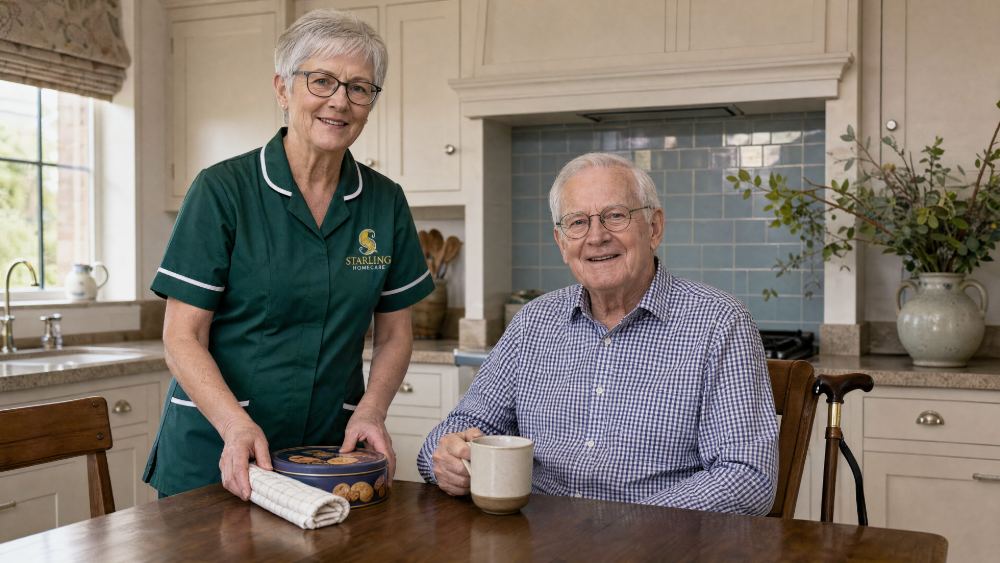
Living alone after a stroke is possible for many people, but the question their family asks first is whether it is safe. The honest answer is that it depends, and that it can change. Some people manage well on their own. Others manage with a few adaptations and regular help, and some need more. This guide sets out what usually decides it, and what can be put in place at home.
Starling Homecare is an independent, family-run provider of care at home across Hertfordshire, regulated by the Care Quality Commission. The details below come from the Stroke Association and the NHS, checked on 29 September 2026, and they are a starting point for a conversation with the stroke team, not a substitute for it.
Living alone after a stroke: the questions that matter
There is no single test. The stroke team looks at the person, their home and the help around them. These are the questions we hear families asking, and they are worth putting to the team before discharge:
- Can they get around the house, up the stairs and in and out of the bath or shower without a fall?
- How tired are they, and does the tiredness make afternoons or evenings harder?
- Are memory, concentration or communication affected, and can they call for help or answer the door?
- Can they manage meals and medication without support?
- What happens on a bad day, and who would know?
The NHS says a stroke recovery plan can include physiotherapy, help with speech, swallowing and vision, activities for memory and concentration, and talking therapy for anxiety, low mood and tiredness. Healthcare teams build a plan for recovery at home and provide equipment with training. If the answers change over the first weeks, so can the arrangements.
The occupational therapy home visit
The Stroke Association describes occupational therapy as re-learning or adapting everyday activities so that someone can lead a full and independent life. An occupational therapist can visit the home to assess it and advise on useful adaptations, looking at things such as furniture height, bathroom fixtures and stairs. They may recommend equipment such as non-slip mats, adaptive cutlery, raised toilet seats or shower seats, and some of it can be loaned free by the NHS or the local council.
Minor adaptations are provided free, and for bigger changes a stroke survivor may apply for a Disabled Facilities Grant from the council, which can be means-tested in England. To ask for an assessment after discharge, you can ask the GP for a referral or contact the council's adult social care department directly, and in some areas you can refer yourself.
Tiredness, and why it changes the plan
Tiredness is easy to underestimate. Someone who copes well at ten in the morning may be unable to cook by five, and a household that looks safe on a good afternoon may be risky at night. That is why the plan often works best when it follows the person's day, with help at the times that are hardest rather than an even spread of hours. If the same problem appears in a different condition, our guide to whether someone with FND can live alone covers a similar question.
How our care at home supports someone living alone after a stroke
We support people after a stroke with visiting, overnight and live-in care. For someone living alone, the first arrangement is often short visits at the hard points of the day: a morning visit to help with washing and dressing and to prompt medication, a meal at lunchtime or teatime, and an evening check. A carer who sees the person regularly notices changes early, such as new unsteadiness or a missed meal, and reports them to the family and the stroke team.
Some people add overnight cover for a period, or move to live-in care if living alone stops being safe. Others need less as recovery progresses, and the plan can reduce as well as grow. Our guide to stroke support in Hertfordshire explains which NHS services cover which stage, and our stroke care page sets out what we provide. Visiting care starts from £34 an hour, VAT exempt, with the price agreed after an assessment.
Where we support people after a stroke in Hertfordshire
Our carers support people after a stroke across all ten of the areas we cover. In addition, each has its own local team and number.
- St Albans: 01727 324 127
- Harpenden: 01582 824 830
- Welwyn Hatfield: 01707 714 000
- Potters Bar: 01707 714 000
- Hemel Hempstead: 01442 954 137
- Berkhamsted: 01442 954 137
- Tring: 01442 954 137
- Hitchin: 01462 534739
- Hertford: 01920 746779
- Radlett and Shenley: 01923 988 550
Common questions about living alone after a stroke
Does Starling Homecare provide care for people living alone after a stroke?
Yes. We provide visiting, overnight and live-in care for people recovering from a stroke across Hertfordshire, and many people start with short visits at the hardest points of the day and change the plan as they recover.
Can someone live alone after a stroke?
Many can, and it depends on mobility, tiredness, memory and communication, medication and what support is around them. The stroke team and an occupational therapist can assess the home and advise on adaptations and equipment.
How do I ask for an occupational therapy home assessment?
Ask the GP for a referral or contact the council's adult social care department directly. In some areas you can refer yourself. The Stroke Association also recommends a review about six months after a stroke.
Arranging Care Is Simple
Starting care can feel like a big step. We keep it calm and straightforward, and we are here to guide you from your very first call.
1. Talk to us
Get in touch by phone or request a callback. We will listen, answer your questions and help you understand the options, so you can decide what feels right in your own time.
2. A home visit and initial consultation
We arrange a visit to understand your routines, your home and what matters most to you. Together we agree an initial consultation and shape the support that feels right.
3. Your care begins
A small, familiar team starts your care, arriving at the agreed times and staying involved as your needs change. We remain your trusted adviser throughout.
Whenever you are ready, we are here to help.