
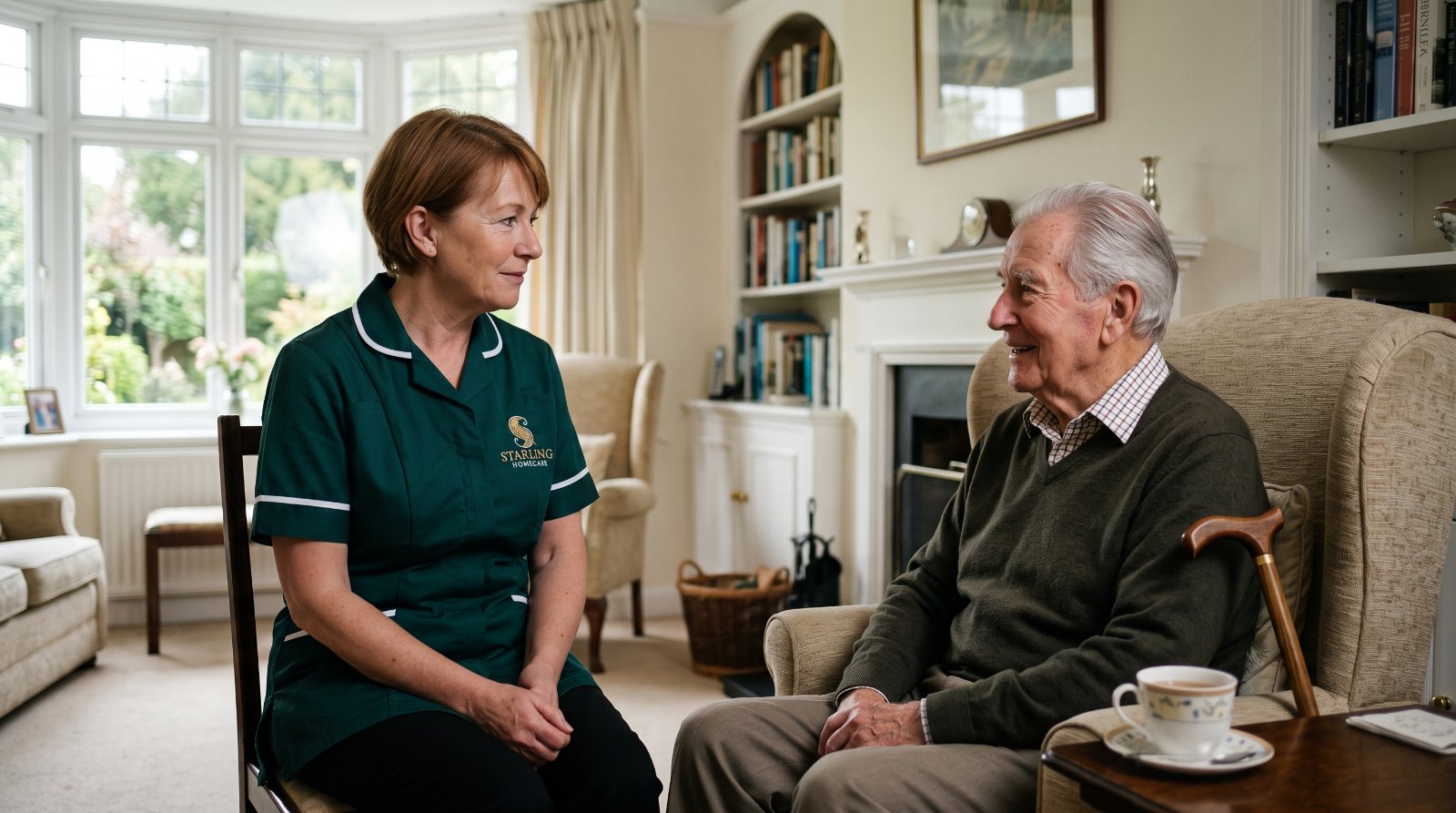
If you are weighing home care or a care home in Harpenden, the decision rarely turns on which is better in general. It turns on four specific questions about one person's days and nights, and once you have answered those, the right option usually becomes obvious.
Most families do not start there. They start by searching for care homes, because that is the phrase everybody knows, and often because something has just happened: a fall, a hospital discharge, a call from a neighbour. The search feels like the responsible thing to do. It is also, for a lot of people, a question asked too early.
This is not an argument against care homes. A good one is a genuinely good answer for the right person, and there are people for whom home is no longer a kind place to be. It is an argument for working out what has actually stopped working before choosing where someone should live.
Why the search usually starts with a care home
Two reasons, and neither is irrational.
The first is visibility. Care homes are buildings with names and websites. Home care is a service, so it is harder to picture until someone explains it. The second is that families often reach for the option that feels like it solves everything at once, particularly when they are exhausted and frightened.
What gets missed is that the two are not on the same scale. A care home replaces the whole of daily life in one move. Home care can start with three mornings a week and grow only as far as it needs to. Starting with the largest available answer to a problem you have not yet defined is how families end up with a bigger change than the situation required.
Home care or a care home in Harpenden: the four questions that decide it
Rather than comparing the two options in the abstract, work through these.
1. What happens at night? Daytime difficulties can nearly always be met with visits. Nights are the honest test. If someone is up and disoriented at three in the morning, or falling on the way to the bathroom, visiting care is not designed for that. The options then are live-in care or a residential setting, not more daytime calls.
2. Is the house helping or fighting them? A Harpenden Victorian semi with a steep staircase and a bathroom upstairs is a different proposition from a bungalow or a level-access flat. Sometimes the barrier is the building rather than the person, and a stairlift, a downstairs bed or a grab rail changes the answer entirely.
3. How isolated are they, really? Loneliness is the argument for a care home that families most often understate. If someone sits alone from Tuesday to Sunday, the case for a place with people in it is real. But that is a case for company, and company can also be arranged at home, which matters if the person would find communal living difficult.
4. Who is holding this together, and how are they? Usually a daughter or a son, often working, frequently not sleeping. If the family carer is at the end of their reserves, that is a genuine factor and it deserves to be named rather than felt guiltily. It does not automatically point to a care home. It points to needing proper support, which respite and regular visits can also provide.
What tips the balance towards a care home
Being straight about this matters more than being reassuring.
A care home tends to be the better answer where needs are high around the clock and unpredictable, where someone needs the reassurance of people nearby at all hours to feel safe, where the house cannot be made to work and moving is not realistic, or where a person is happier among others than they would be at home with visitors. Advanced dementia with significant night-time disturbance is the pattern that most often makes residential care the kinder choice.
If that describes the situation you are looking at, then looking at homes is the right use of your time, and no home care provider worth speaking to will tell you otherwise.
What makes staying at home work in Harpenden specifically
Where home care does work, it works better in a town with a dense local network, and Harpenden has an unusually strong one.
The Harpenden Trust runs a befriending service providing regular company for older people living on their own who struggle to get out, alongside two weekly coffee mornings, one at the Trust Centre on Southdown Road and one at the Salvation Army on Leyton Green. It also runs a Memory Lane Café for people and families living with dementia, on Monday afternoons at the Salvation Army with Harpenden Town Council, and its Wellbeing Friends service takes referrals from Harpenden's three GP practices through their social prescribers.
None of that replaces care. What it does is make the difference between someone being at home and someone being stuck at home, which is the distinction that decides whether staying put is a good life or a slow retreat. When families tell us home care is working, this is usually why: paid support handles the difficult parts of the day, and the town handles the rest.
Countywide, Hertswise offers community dementia support for people with dementia, memory loss or mild cognitive impairment and their carers, with an open referral system so you can refer yourself. Hub sessions ask a five pound contribution and carers attend free.
The cost question, without the fudge
Families expect home care to be the cheaper option and are sometimes surprised. Below roughly the level of a few visits a day, home care generally costs less than residential fees. Above it, the two converge, and once round-the-clock cover is needed the comparison depends on whether one person or two are being supported in the same house, which is where live-in care often becomes the better value.
Two things are worth doing before you compare numbers. Ask Hertfordshire County Council for a needs assessment, which is free, which everybody has a right to, and which commits you to nothing. And check entitlements, because attendance allowance is not means tested and a lot of families discover it late. Our care funding guide walks through both.
Questions Harpenden families ask
Is home care always cheaper than a care home in Harpenden?
Not always. It is usually cheaper at lower levels of support and roughly comparable once someone needs cover through the day and night. The variable that matters most is how many hours are genuinely needed, which is why an assessment is worth more than a price list at this stage.
Can home care manage dementia, or is a care home safer?
Home care manages dementia well in the earlier and middle stages, particularly where familiar surroundings reduce confusion, and familiarity is genuinely therapeutic. Where night-time disturbance, wandering or significant risk appear, live-in care or a residential setting usually becomes the safer answer. It depends on the stage rather than the diagnosis.
What if we try home care and it is not enough?
Then you will know something you could not have known in advance, and you will have lost nothing. Care can be increased, changed to live-in, or stepped to residential care with far better information about what the person actually needs. Trying the smaller option first is not a delay tactic, it is how you avoid an irreversible decision made on a bad week.
How do we raise it without a row?
Start with the task, not the label. Almost nobody agrees to accept care; plenty of people agree to someone helping with the shopping on Tuesdays. The word tends to follow the arrangement rather than precede it.
Where to start
If you are somewhere in the middle of this for someone in Harpenden, the most useful next step is usually to get clear on what specifically has stopped working, before deciding where they should live. It often helps to talk it through with someone who arranges care every day and who will tell you honestly if a care home is the better answer.
Our county guide on home care or a care home covers the general comparison, and you can read about how we work locally on our Harpenden home care page or about round-the-clock support on our live-in care in Harpenden page.
Arranging Care Is Simple
Starting care can feel like a big step. We keep it calm and straightforward, and we are here to guide you from your very first call.
1. Talk to us
Get in touch by phone or request a callback. We will listen, answer your questions and help you understand the options, so you can decide what feels right in your own time.
2. A home visit and initial consultation
We arrange a visit to understand your routines, your home and what matters most to you. Together we agree an initial consultation and shape the support that feels right.
3. Your care begins
A small, familiar team starts your care, arriving at the agreed times and staying involved as your needs change. We remain your trusted adviser throughout.
Whenever you are ready, we are here to help.